

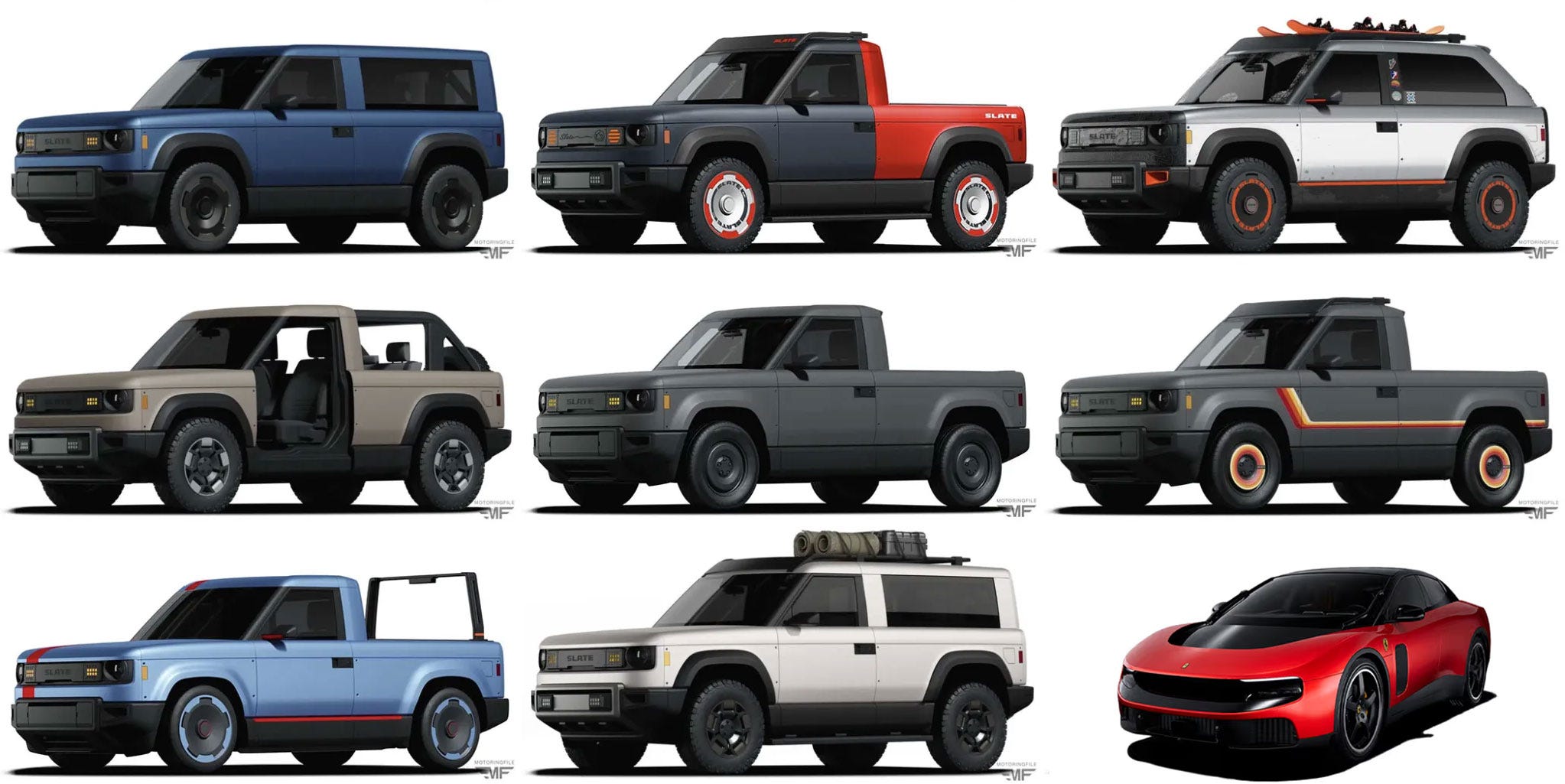
Someone looked at the automotive industry and realised the entire ownership model is built backwards. We construct vehicles where the heaviest, most energy-intensive, most durable component, the chassis, the frame, is designed to be disposable. Everything bolted or welded onto it, everything that actually degrades, everything that could be refreshed or upgraded, is fused into a single irreplaceable unit. We throw away the permanent to chase the new. Slate Auto has rejected that logic entirely.
Instead, the frame becomes perpetual. The battery, the cabin, the drivetrain, the technology, all of it modular, all of it swappable, all of it architected for renewal. You don’t buy a truck and own it for ten years then scrap it. You own a frame. The vehicle evolves with your needs and with technology. The battery degrades, you swap it. The cabin needs modernising, you reconfigure it. The drivetrain improves, you upgrade it. Over decades, not model cycles. That’s the structural argument Slate is making. Not jargon about sustainability or circular economy. About what ownership actually means when the heaviest, most energy-intensive-to-construct aspect of the vehicle is permanent, and everything mounted on it is fluid.
Now contrast that with what Ferrari just announced. The Luce arrived a few weeks ago to a wall of negativity. Mostly aesthetic. People hated the proportions, the front end, the way it looked nothing like a Ferrari. But the design backlash is surface noise. What the Luce actually represents is Ferrari’s central problem: how do you preserve the narrative of a brand built on a century of heritage, exclusivity, performance mythology, and engine sound, when the fundamental technology has shifted entirely underneath?
Ferrari’s trying to translate heritage into a form that no longer supports it. The design language that made sense with combustion, with mechanical viscerality, with sound as a core part of the experience, becomes decorative when the engine is silent and the performance envelope has been completely rewritten by EV torque and acceleration. That’s not a design problem. That’s a narrative problem.
And it’s the trap every legacy automaker faces. But Ferrari faces it most acutely because Ferrari’s entire value proposition has always been built on scarcity, exclusivity, and the cultural mythology around what a Ferrari means.
Ferrari’s entire demand model is built on deliberate scarcity and restriction. You don’t simply buy a Luce. You earn access through a hierarchy of loyalty. Only Ferrari’s most committed customers can access the newest models. That restriction, paradoxically, is what generates the cultural heat. The Luce becomes desirable not because of what it is, but because of what owning it signals: you’re deep enough in the Ferrari ecosystem to have been chosen.
The sales numbers in China look strong. But they’re masking the real dynamic. Many buyers already own multiple Ferraris. They’re not buying the Luce because they believe in it as a vehicle. They’re buying it to maintain their position in the queue, to preserve access to future models, to keep their membership card valid. It’s not product demand. It’s status insurance.
This is where the model becomes brittle. Ferrari can sell failure as long as the exclusivity signal holds. But the moment that signal fractures, the moment people realise they can get genuine performance innovation elsewhere, those sales evaporate. And electrification has already fractured the signal. An EV from Porsche, from Lotus, even from a startup, can now match or exceed Ferrari’s performance. The scarcity model depends entirely on Ferrari being credibly at the pinnacle. Once that credibility cracks, you’re left with a hollowed-out brand that pulled itself into a corner.
What Slate understands, and what legacy auto has deliberately avoided talking about, is that electric architecture itself enables modularity in ways combustion never could. An ICE engine is a quagmire of interconnected systems, everything dependent on everything else. But electric componentry is naturally modular, wirable, swappable. The battery, the motors, the software stack, the chassis management, they don’t need to be fused into a single irreplaceable unit. They can be architected for composability from the ground up.
NIO proved this concept with battery swapping. You can change your power source, extend your range, upgrade your capacity without scrapping the vehicle. But NIO stopped there. They optimised for convenience within the old ownership model. Slate went deeper and built the entire architecture around modularity as the central principle. Automotive’s Fairphone equivalent.
And this is where the industry’s silence becomes telling. Legacy auto hasn’t talked about repairability, upgradability, interchangeability, because doing so threatens the entire economic structure they’ve built. Product lines optimised for obsolescence. Financing models that depend on constant replacement. Residual values managed through artificial scarcity and consciously shortened lifespans. Modularity breaks all of that. It’s not a feature they’re unaware of. It’s a threat to be avoided for as long as possible.
Slate arrived and said: what if the vehicle wasn’t designed for disposal, but for renewal? What if every component was architected for swap, repair, upgrade? Electric makes that structurally possible in ways it never was before.
Slate is practising cultural engineering. Not in the cynical sense of greenwashing or co-opting language. In the structural sense of creating pathways for adoption that don’t require people to abandon their values or their identity.
The truck itself is the first move. The truck is coded as masculine, self-reliant, freedom. In American culture, that’s not woke territory. By building modularity and circularity around the truck form, Slate sidesteps the entire framing trap that’s killed sustainable tech adoption in red states. You’re not buying an electric virtue signal. You’re buying a truck that works harder and lasts longer because you can fix, upgrade and customise it.
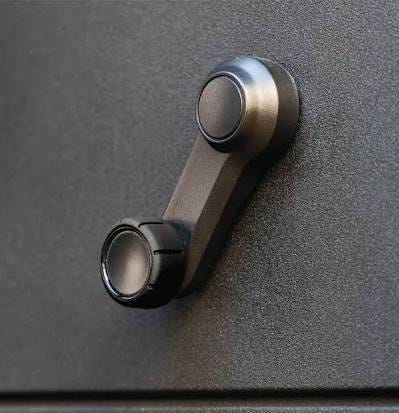
Then there’s the hand-crank window on the base model. No vehicle on the market today has manual windows. It seems unacceptably retrograde. But the symbolism is potent. As vehicles have become locked-down software boxes, every added technology has stripped away user control. The hand-crank window is a deliberate provocation. It says: you own this machine. You operate it directly. No intermediary, no subscription, no dependency, no fumbled execution by a poorly functioning voice command. That’s not nostalgia. That’s reclaiming the original truck ethos, the self-determination that trucks have always represented.
And the proof is Texas. Red states lead the US in solar adoption not because they’ve embraced environmentalism, but because solar represents energy independence. Self-reliance. Control. Sustainability framed as surrender fails. Sustainability framed as mastery succeeds. You might not side with the politics, but if impact is the objective, opening this path is key.
Slate understands this. Every design choice is cultural armour and genuine philosophy at once.
American auto is trapped in a mythology it can no longer afford. The truck has always represented freedom, self-reliance, masculine independence. That’s cultural bedrock. But the EV transition threatens that mythology directly. Range anxiety becomes a proxy for emasculation. Software dependency reads as surrendered control. Every technological advancement feels like a constraint on freedom rather than an expansion of it.
This isn’t irrational. It’s deeply emotional. American truck culture is built on the idea that you own your machine, you understand it, you can fix it, you control your destiny through it. The more a vehicle becomes a locked-down software box, the more it violates that foundational belief.
Legacy American automakers are paralysed by this contradiction. They’re trying to sell electric as progression when their market experiences it as surrender. They’re offering more technology at higher and higher prices when their customers want more agency at an affordable level. So they hedge, they drag, they produce half-measures that satisfy nobody.
Into that paralysis arrives Slate. A truck that restores agency instead of demanding it be surrendered. Modularity as self-determination. Repairability as mastery. The ability to upgrade, to adapt, to own your vehicle in the fullest sense. It doesn’t ask Americans to abandon their truck mythology. It asks them to reclaim it.
Meanwhile, China is winning the performance-price-range game with extraordinary force. Example: the Xiaomi SU7 Max: 2.28 sec 0-62, 497 mile range, software experience mastery, $42k list price in China, locked out of the US behind tariff walls. This is faster-better-cheaper executed flawlessly. But it’s still operating within the old automotive paradigm: buy the newest, chase the next generation, accept replacement as inevitable.
What neither China nor legacy American auto is doing is what Slate is doing: rethinking the fundamental structure of what a vehicle is, what ownership means, what value actually consists of across decades.
The prompt for this piece was Tom Goodwin’s post where he leaves on a mixed note of optimism for the idea but pessimism for the success of the Slate as a business in the longer term. Maybe too many progressive EV auto startups on the scrapheap to hope for another..? But whether Slate survives or not is almost beside the point. It’s already done the cultural work. It’s proven the possibility. It’s shown the market, shown every competitor, shown the industry itself that there’s a completely different way to think about vehicles, ownership, longevity, user agency, circular economics. You can’t unsee that.
That’s the lightning rod effect. The first mover doesn’t always dominate. But they announce the new game. They establish what’s possible. And once possibility is established, it spreads. China will eventually ask the modularity question. Legacy auto will eventually have to answer it. Not because Slate forced them, but because the cultural needle has shifted. The genie is out of the bottle.
So the contrast becomes clear. Ferrari is defending the past, trying to translate heritage narrative into a form that no longer supports it, building scarcity into a moment demanding abundance. Slate is announcing the future, not through hyperbole or marketing language, but through structural choices that redefine what a vehicle can be.
One is defending the past. One is announcing the future
.
Thanks Nicolas thought provoking as ever. As I was reading it, I had a few thoughts:
- Slate feels like the kind of vehicle that Dieter Rams would have designed in terms of how it complies with his 10 rules of good design.
- Philosophically Toyota, VW Group and even GM aren't a million miles away from Slate with the idea of family platforms. It's where they go from there that is the failure. I thought that Slate owes as much to the AR-firearms system in terms of its core approach of modularity. If they took their basic truck to SEMA for the third party and tuner day, allowing their vehicle to be 3D scanned as Toyota does with the Tacoma, Forerunner and Land Cruiser then the third party support for it could explode. Better still post CAD files and specs for the modular connectors on Github to make them accessible.
- I found certain parallels with Toyota's Hilux Champ that they have launched in Thailand and the Slate in terms of its back to basics nature. More on that here: https://www.toyota.co.th/en/model/hilux_champ/specification
- I suspect that so many consumers in many western countries have now become acclimated to vehicles as computing platforms that happen to move that there may be friction between the Slate experience and Europeans. I think thats a real shame, but then I grew up driving literal bangers like a Polish made Fiat 126 and a mk II Ford Fiesta van with a transplanted diesel engine in the the front of it. The idea of an automotive equivalent of a Punkt phone appealed a lot.
- I would like to see regulation around ADAS systems pared back to a sweet spot in terms of simplicity and more emphasis put into optimal HCI rather than the current experience of malicious compliance that we have.