

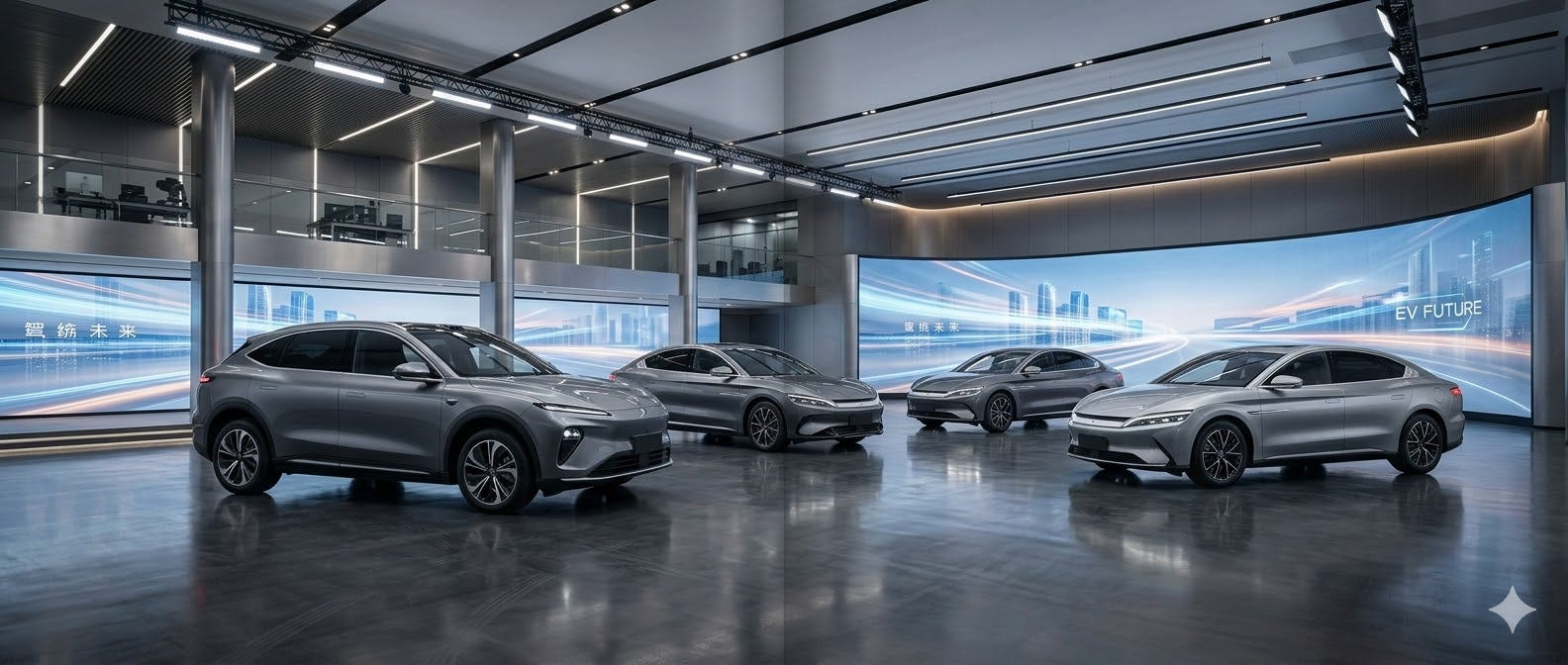
I spent a few years on the Coolbrands council, the annual ritual of picking the world’s coolest brands. That was a while ago. I wouldn’t claim to be the bellwether of cool in any general sense today. But I know a cool car brand when I see one. And I’m not seeing one
WHAT THEY’RE GETTING RIGHT
Tick. Tick. Tick. The Chinese EV proposition on paper is formidable. Vertical integration drives price points that Western brands can’t touch. Specs and performance that compare favourably across the range. Features that would have been flagship territory three years ago are now standard. The engineering story is genuinely impressive. The uptake graph is northbound. So far so good. But not so fast!.
THE TSUNAMI
This isn’t one or two brands testing the water. It’s a tsunami. In the last two to three years, the following Chinese marques have either launched in the UK and Europe or are actively preparing to:
BYD MG (SAIC) Nio Xpeng Ora (Great Wall) Lynk & Co (Geely) Polestar* Zeekr (Geely) Leapmotor (Stellantis) Omoda & Jaecoo (Chery)Deepal (Changan) Voyah (Dongfeng) Avatr (Changan/Huawei) AITO (Seres/Huawei) Human Horizons (HiPhi) BAIC GAC Aion
That’s not a competitive set. That’s a traffic jam! All arriving at roughly the same time, with broadly similar propositions, fighting for the same sceptical Western consumer. In that environment, differentiation isn’t a nice-to-have. It’s the only thing that matters.
THE GENERIC TRAP
Every one of these brands has made the same strategic calculation: occupy the middle ground. Don’t alienate anyone. Appeal to the mainstream. The result? They’ve all arrived wearing the same outfit.
The design language is generic. The colour palette is generic. The infotainment UI looks like an Android phone that nobody’s customised and breathed a sense of distinct brand into. The marketing reads like it was written by a committee that’s never heard of culture.
This isn’t a coincidence. It’s a strategy. One that will fail.
WHY GENERIC IS TERMINAL
When you’re trying to establish a brand in a crowded market with no legacy recognition, generic is not a safe harbour. It’s a death sentence. Without distinctive visual identity, without cultural leverage, without anything to anchor loyalty, you’re entirely exposed. The next brand with a slightly sharper price point takes your customers. There’s nothing to hold them.
And the competition is only accelerating. More brands. More similar propositions. More price compression. In that environment, the brands without equity will simply bleed out.
THE MARKETING INDUSTRIAL COMPLEX MAKES IT WORSE
When Chinese brands enter a Western market, they follow a playbook. Engage established auto marketing agencies. Run the standard channels. Target the standard segments. Deploy the standard offer mechanics.
The problem is that auto marketing as an industry is deeply stuck. It built sophisticated machinery for a different era, segmentation matrices, persona frameworks, attribution modelling and mistook that sophistication for progress. The whole apparatus got more and more technically precise about reaching people while quietly forgetting to ask whether anyone actually wanted what it was reaching them with.
Offer-based performance mechanics don’t build brands. They erode them. Every discount is a withdrawal from an account that has never been duly never funded.
The Chinese brands inherit this myopia wholesale. They could do something completely different, build genuine cultural affiliations, activate subcultural communities, use digital-native approaches that create advocacy rather than just moving metal. Cultivate a vibe. Instead they slot straight into the tired playbook and will wonder why the margins keep compressing.
THE OPTIMISATION TRAP
There’s a parallel with performance marketing worth referencing. When you see the world entirely through metrics, when you’re always chasing the bigger number, you mistake optimisation for progress. In reality you’re constantly closing down avenues. The algorithm pulls everything toward the centre. Convergence is the inevitable output of a system designed only to maximise measurable outcomes. This explains the sameness we see everywhere. Not just in cars. Streaming content. Hotels. Coffee brands. Fashion. The relentless pursuit of the addressable market produces a world of extraordinary, suffocating uniformity. Which, as it happens, creates a brilliant backdrop for anything that dares to be different!!!
SO WHAT GOOD LOOKS LIKE? KIA
Kia didn’t stumble into coolness. They committed to a radical design vernacular and then applied it with total discipline across their entire EV range. Not one bold model and then back to safe. The whole range. Mutually reinforcing. Coherent. Unmistakably Kia.
That repetition matters. It’s what takes a design choice and turns it into a visual language, something that embeds itself in culture, something that becomes recognisable, something that becomes genuinely defensible. You can’t easily copy a language. You can copy a shape.
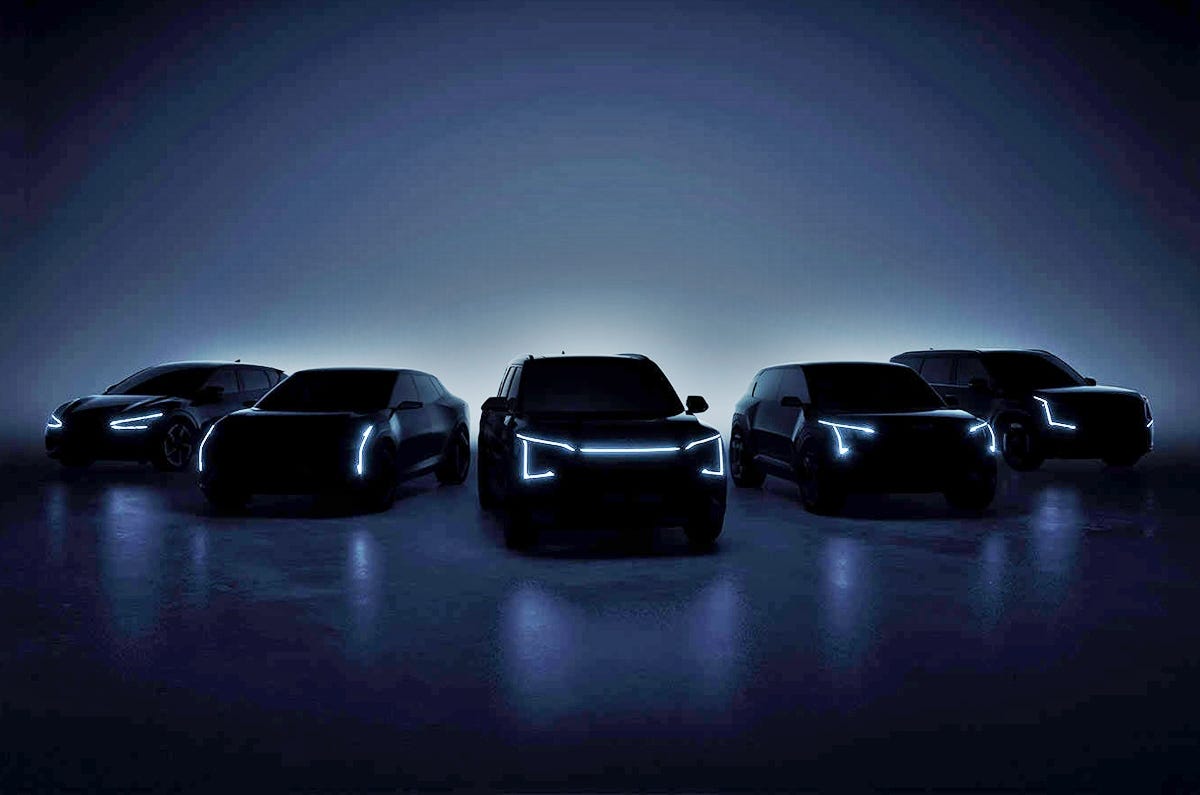
And crucially, this vernacular belongs to the EV line specifically. The signal is unambiguous: Kia are not hedging. They are not serving the doubters. They are committed to an electric future and they want you to know it. That clarity is itself a premium signal. And all this badged by Luc Donckerwolke incredibly cool and distinctive logo that’s pure, futuristic, confident optimism. There’s an indisputable through line. If I was on the Coolbrands council today they’d be my number 1 in auto.
The evidence that connects their strategy and execution with real value is in the numbers. While the wider European car market shrank 4.1% in 2022, Kia grew to a record 4.8% market share. By 2023, best year in the brand’s history, 572,000 units sold across Europe, EVs making up 38% of that total. In the UK, third best-selling electrified brand, sixth overall. The EV6 won Car of the Year, first time ever for a Korean brand. None of this is accidental. It’s what happens when you commit to a design language and don’t flinch. And I think they’re only getting started as the foundations are still falling into place (e.g. The recent addition of the EV2 which will certainly gain kudos from cool urban customers.)
IF IT’S BROKE. FIX IT
Modern auto marketing has become extraordinarily technical. Nuanced segments matched to ever more niche personas. Attribution models of dazzling complexity.
But it has almost entirely forgotten to ask: is this cool?
Cool isn’t a segment. You can’t A/B test your way to it. But brands that achieve it, brands with genuine cultural magnetism, tend to find that the segmentation problem largely solves itself. People self-select. Advocacy does the heavy lifting. The margins hold.
Chinese EVs have every advantage except the courage to be interesting. The backdrop is so flat that standing up could be almost effortless. So stand up.
Give me a shout if this resonates. I have a very different plan for how this can work.
Hi Nicolas, did you know that Chinese EV’s are suspected to be spying platforms transmitting data back to China. That’s particularly an issue with the military https://inews.co.uk/news/electric-cars-chinese-parts-banned-from-military-sites-spying-fears-3644639