

I co-founded Plumen, a pioneering light bulb brand that rode the disruptive transition from incandescent to energy-efficient technology, a shift driven by regulation, economics, and the push toward net-zero. I also spent decades leading creative at Poke, an award winning creative technology agency, working with telcos like Orange, EE, and Skype (RIP 😢), trying to weave a thread between traditional brand, digital product and service, and brand communications, basically anything digital and social media based. I worked with pioneering fintech brands like Zopa and cruise disruptor Virgin Voyages, all examples where foundation-level disruption was taking place, where radical rewiring was needed and a new style and spirit had to emerge to drive a wedge between category leaders and the laggards.
It’s this combination, entrepreneurial product experience and digital creative leadership, that taught me something important: technological disruption alone doesn’t determine winners. The winners are those who find the through line connecting strategy, execution, and brand narrative, who understand that economics, functionality, and meaning must work together.
Automotive is a notoriously closed shop. I’d love to swing in and help, but the industry doesn’t easily welcome outside expertise, something we’ll come back to. I even feel awkward writing this because I know car people will immediately dismiss my POV on account of me not having been hazed into their cult. So I’ll stay on the sidelines and offer a few observations, because right now, I believe we’re witnessing a genuine historical inflection point in transportation.
Mainstreaming
This year EVs are hitting price parity with ICE vehicles in the smaller vehicle segments, where the real volume and impact is. Factor in incentives and lower running costs, and total cost of ownership now genuinely favours electric for many buyers. In many countries, charging infrastructure has reached credible levels, not perfect, but good enough that range anxiety is fading for typical use cases. Battery performance has increased significantly while costs continue to fall, and the vehicle experience is now exceeding ICE in nearly every respect. There’s also new battery chemistries around the corner with the likes of CATL touting sodium based solutions, light on rare earth usage and could shave another 3rd off battery costs within a few of years. So a gap will soon emerge withEV economics really driving a wedge. Government legislation may have weakened under lobbyist pressure, but the tanker is now in full tilt turn without it.
YouTuber Marques Brownlee recently demonstrated the Xiaomi SU7 in this video, a vehicle he concluded would be priced around $100k in the US for equivalent quality, experience, and performance, compared to its actual sale price of around $45k in China. That gap tells you everything about where the technology and manufacturing capability has already reached today.
We’re already seeing acceleration in uptake. UK BEV sales hit 32.7% in December. Once you cross 30% in a market, you typically hit the adoption curve acceleration phase, moving from early adopters to pragmatic majority territory. Norway’s already at 90%+, showing what’s possible.
This isn’t about one breakthrough, it’s about multiple mature technologies and cultural acceptance combining to hit economic viability and scale simultaneously. Four major friction points dissolving at once creates compounding momentum.
Post-pioneer products
What makes this moment different is that manufacturers have learned how to make EVs for normal people, not statements, not compromises, just better vehicles.
The Renault 5 is masterclass product design. They’ve understood that the pragmatic majority doesn’t want revolution, they want familiar comfort upgraded. The AmpR Small platform delivers genuine EV benefits wrapped in something that triggers positive emotional memory. Heritage reimagined rather than future imposed.
BYD’s strategy is even more telling. While Tesla had to sell “the future” to early adopters with radical styling and interface disruption, BYD correctly read that mass market wants conventional good cars that happen to be electric. Boring boxes that work brilliantly. They’ve stripped out the ideological baggage and focused on making cheaper, better transport. That pragmatism is why they’re winning globally while Tesla plateaus.
BMW’s Neue Klasse represents legacy manufacturers finally committing rather than hedging. Five-hundred-mile range and a zen design vernacular show they’ve stopped trying to preserve ICE business models and actually designed EV-first. The fact it took them this long is damning, but the fact they’re here now matters.
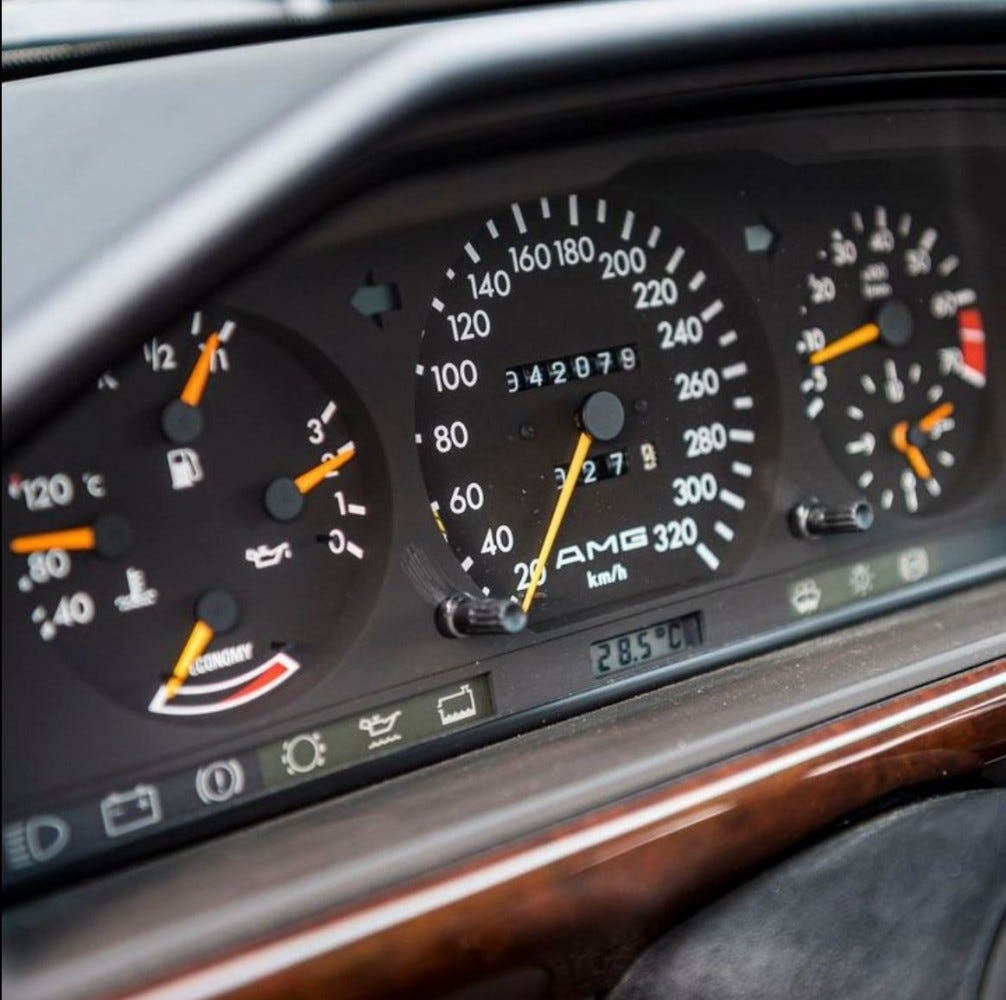
The HMI mess
But it’s not all plain sailing. HMI performance and design is a mess across the board. No brand is really nailing it in my view (as someone who has worked with GUI’s for 30 years in some for or other). Some are reaching decent levels of performance, but even those most often lack distinctive personality, typography, and clear graphical integrity.
Even Kia, whose dedicated EV lineup sets the bar for cross-range signature style from an exterior and interior design standpoint, doesn’t follow through with enough commitment in the HMI. A lost opportunity, though they’re the closest to the ideal.
The norm is some kind of skeuomorphic representation, softened to a fault. Button forms and treatments are still borrowed from smartphone vernacular, which misses a trick in establishing new specific forms for the larger, often fragmented screen real estate and the specific needs of a driver in various contrasting contexts.
I still love old Mercedes dial graphics and layouts (pictured above). Porsche too. In fact, I recall hearing, possibly on Nilay Patel‘s Decoder podcast, about Porsche and Apple negotiating over typography (San Francisco) when integrating CarPlay more deeply into Porsche’s HMI. To me, Porsche typography is historically not only the pinnacle of perfection, but also as inextricably linked to the brand as their distinct engine rumble.
As the Brownlee video shows, these driver experience elements aren’t arbitrary add-ons anymore. The degree to which they’re meaningfully integrated into the driver experience directly impacts brand impression. It’s why the SDV, software-defined vehicle, has become such a critical topic lately. Only an integrated stack can fully orchestrate the vehicle, both as a means of moving and as a distinct experience.
The Chinese flood
Which brings us to the commoditisation problem. Nine Chinese brands launched in Europe between 2020 and 2025: BYD , NIO , XPENG , OMODA UK , JAECOO UK , Leapmotor , Zeekr Europe , Hongqi, GWM, and DENZA EUROPE . Five more are launching this year: Exeed, GAC AION Indomobil , IM Motors , Firefly, and Changan Automobile ‘s Deepal and AVATR Global Design Center brands.
That’s fourteen Chinese EV brands in European markets within six or seven years. For context, it took established European manufacturers decades to build their current positions.
The Chinese inbounds are coming in great numbers, and yes, many represent an upgrade in performance and experience over local rivals at their price points, but they also feel very blobby and generic, with little differentiation in how they operate as images and ideas in the marketplace.
The Xiaomi SU7 might be a supremo product, but it still hasn’t forged an ownable signature. It borrows familiar elements from mainly European marques. When everything looks vaguely Porsche-meets-Tesla and performs similarly well for the price, you get paralysis. The pragmatic majority needs clear reasons to pick this one over that one.
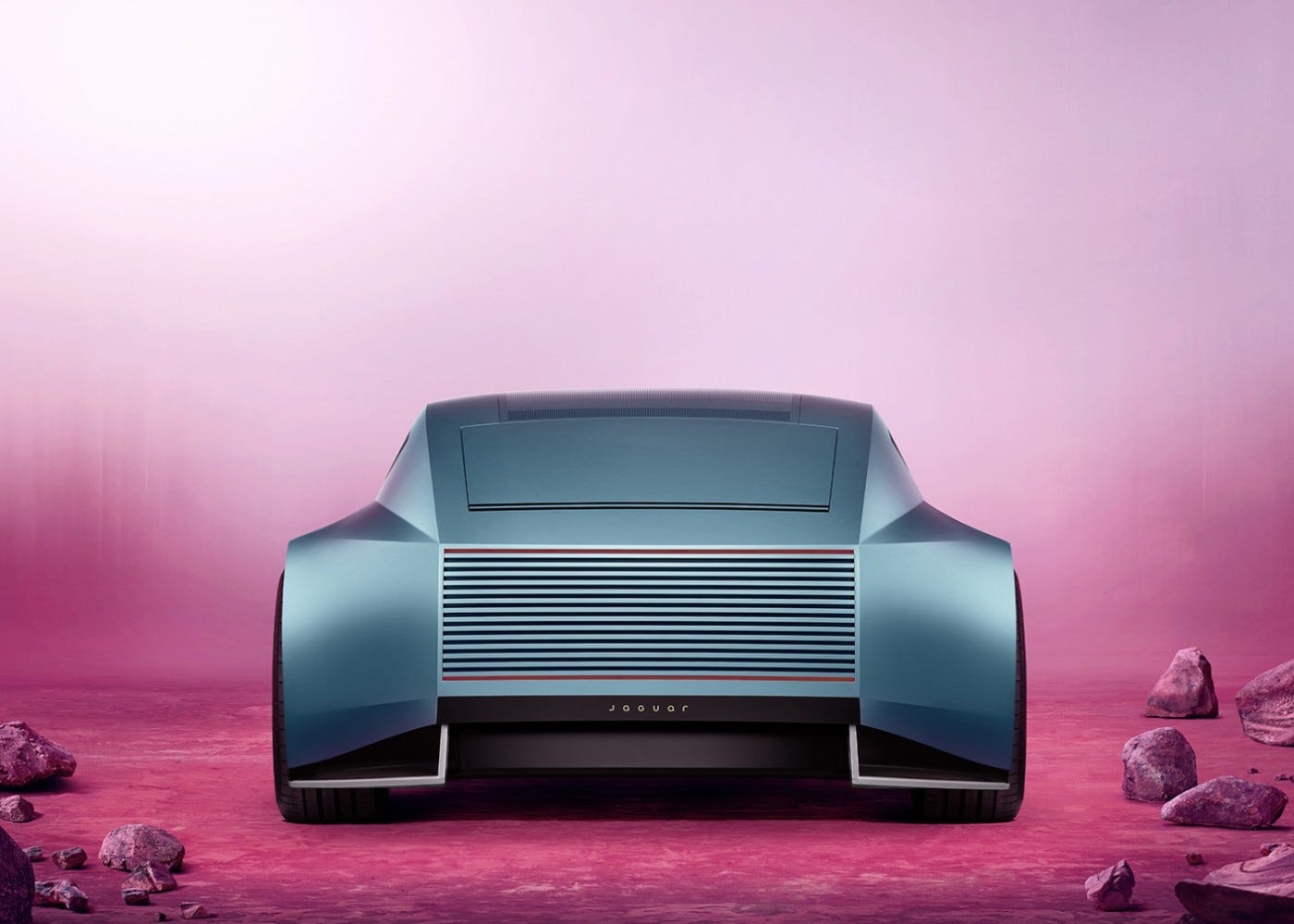
The Jaguar gambit
When you see this sea of undifferentiated competence, you can start to appreciate why Jaguar have taken such radical steps with their rebrand. The Chinese inbounds are perfect assimilations of historic European vernacular design, almost as if they’re the result of a prompt: “Please design a medium family crossover that blends the best of a Macan with a Velar, bringing a bit of Taycan into the front, but make it a bit more neutral and anodyne to ensure mass appeal.”
The only way to mitigate the dangers of being sucked into a soupy vortex of averageness is to take a radical sidestep and create a footprint not present in the vast training set of all that has come before.
With the Plumen project we did exactly the same thing. We knew we needed a completely new language to create the space between us and the rest of the slop the incumbents were producing.
You never know, we may come to view Jaguar’s radical dance moves as the pivot of the century.
The closed shop
When scrolling through LinkedIn, it’s clear why this is the case. Automotive is an exclusive club that doesn’t believe valid ideas and expertise from outside could be valuable, an attitude that leads to peril, as we’ve seen with VW’s disastrous forays into software development, only to forge, under duress, an expensive partnership with UX exemplars Rivian.
They need software and experience expertise they don’t have but won’t let outsiders in until crisis forces them.
What needs to happen
We’re at the tipping point. The acceleration from here will be rapid and irreversible. But for manufacturers who want to survive the next phase, especially Chinese inbounds, competent technology isn’t enough. They need brands that actually mean something, clear identity in how they look, how they operate, what they stand for in the marketplace and in culture.
The interesting challenge: building these brands can’t follow the old playbook. You can’t manufacture heritage or bolt on meaning after the fact. Especially when the EV is a new kind of proposition. These companies need to forge distinct identities from the ground up, through design commitment, experiential coherence, and cultural positioning that reflects what transportation actually means today whilst also preparing for the near’ish term autonomous future. Not nostalgia, not borrowed equity, but genuine new signatures for how we move forward.
Very interesting post, Nick. I watched the same Brownlee review and drew similar conclusions. It’s interesting to look at how China got to the point where the prices they can charge for such high quality products is many times less than those demanded by companies in the West. In this moment of chaos, few in the West seem to be fully understanding how the West got here and how China got there. Voices in China offer an explanation that makes a lot of sense: https://youtu.be/FAnV9lwokOE?si=XszcmDe_ugTmuvi7