

(published in Design Week 1/4/2026)
Most clean technology does not fail in the lab or on the balance sheet, but on the roof, the wall, the driveway or in the living room. Brilliantly conceived, expertly engineered but pitifully ugly, uninspiring products.
This is not vanity. It is a market failure hiding in plain sight.
I have been watching it play out for nearly two decades, starting with Plumen. Back in 2007 the lighting industry had a real problem. How do you get people to switch from incandescent bulbs to energy efficient ones. Every major manufacturer treated it as an engineering and pricing challenge. We thought that was incomplete. The real question was desire. People do not adopt what they do not want.
So we made a bulb worth wanting. We hung the first prototype at Designers Block and the reaction was instant. A full pager in The Times with my quote “Isn’t it strange, an object synonymous with ideas is so absent of imagination?”
We took the idea to every major global lighting manufacturer. Not one of them was interested. They had already decided what kind of problem this was. Technical. Commercial. End of discussion. So we built it ourselves. Today those same manufacturers all sell well designed premium bulbs. The category we had to force into existence is now expected.
This pattern is repeating itself right now across heat pumps home batteries and solar infrastructure. The engineering is often brilliant. The design absent.
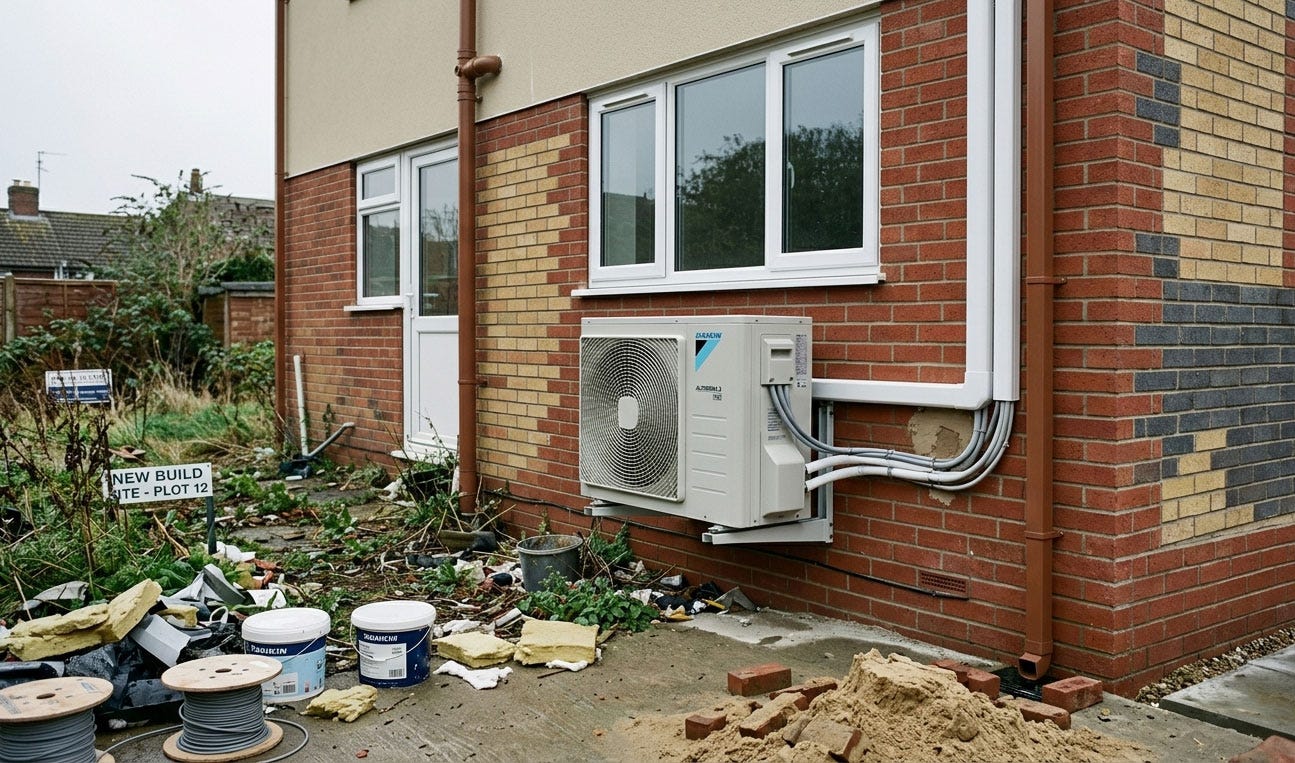
Heat pumps are the clearest example. Large visible and frequently dreadful they are installed around homes as if the people living there are an afterthought. Every ounce of effort goes into performance. Almost none goes into presence. Aria is a rare exception. That tells you everything.
Which brings me to Windfall Energy who launched their home battery this week and took a different approach. They treated it like furniture, not technological gadgetry.
Not a device you tolerate but an object you choose. That is a very different brief. The constraints are real. Batteries are large. Many people live in rented spaces or apartments with nowhere to hide them. The challenge was not to disguise the object but to make it worthy of being seen. Ben King’s solution was simple and radical. Create something that can sit in a main living space with a top surface that adapts to different interiors.
This is exactly the challenge we faced with Plumen. When you introduce something unfamiliar you have to make it feel culturally legible. You have to place it in the same mental category as objects people already love. The iPod did that. They did not apologise for being new. They celebrated it without alienating.
At the Windfall launch event the response was very positive. People were drawn to the object before they understood the function. That is not superficial. That is how adoption begins.
The commercial logic is already there. Battery costs have fallen to the point where potential savings on energy are meaningful. A few hundred pounds a year just by shifting energy use across time. Add a dynamic tariff and smart software and it works. No installation. Just plug it in. For the majority of the country who rent or live in apartments this opens access to the energy revolution that has so far been reserved for homeowners.
But none of that matters if people do not want it in their homes.
This is where design stops being decoration and becomes infrastructure. If the object fails socially it fails commercially and also fails to drive the transition in the right direction.
We are also in the middle of a sustainability disengagement. Not a rejection but a loss of momentum. Some of that is political. Some of it is economic. But some of it is self inflicted. Too many sustainable solutions arrive with the aesthetic sensitivity of a planning notice. They feel imposed rather than invited.
And people resist what feels imposed.
Designers are not going to be invited in. Most engineering led companies still underestimate or misunderstand what design actually does. It is not styling. It is not branding at the edges. It is the mechanism through which new behaviour becomes acceptable. The connection of ideas to culture.
So the burden is on us to prove it. Again and again. Sometimes without permission.
The good news is that the argument is getting easier. When something highly functional can also be genuinely desirable, you do not have to convince people. You remove the friction and the product moves.
The transition does not need more explanation.
It needs desire
.